The Beaufort Wind Force Scale

“And now the shipping forecast issued by the Met Office on behalf of the Maritime and Coastguard Agency at 0505 on Friday the 31st of July...Viking-North Utsire northwesterly 4 or 5, becoming variable 3 or 4, the southerly 5 or 6 later.”
Any sailor growing up in England will immediately remember the voice of the weather reader on BBC Radio 4 giving the latest weather reports and forecasts for the sea areas around the United Kingdom. The numbers in the shipping forecast which define the wind speed are not given in knots, miles per hour, or even in kilometers per hour, but in “force” values from the Beaufort Scale.
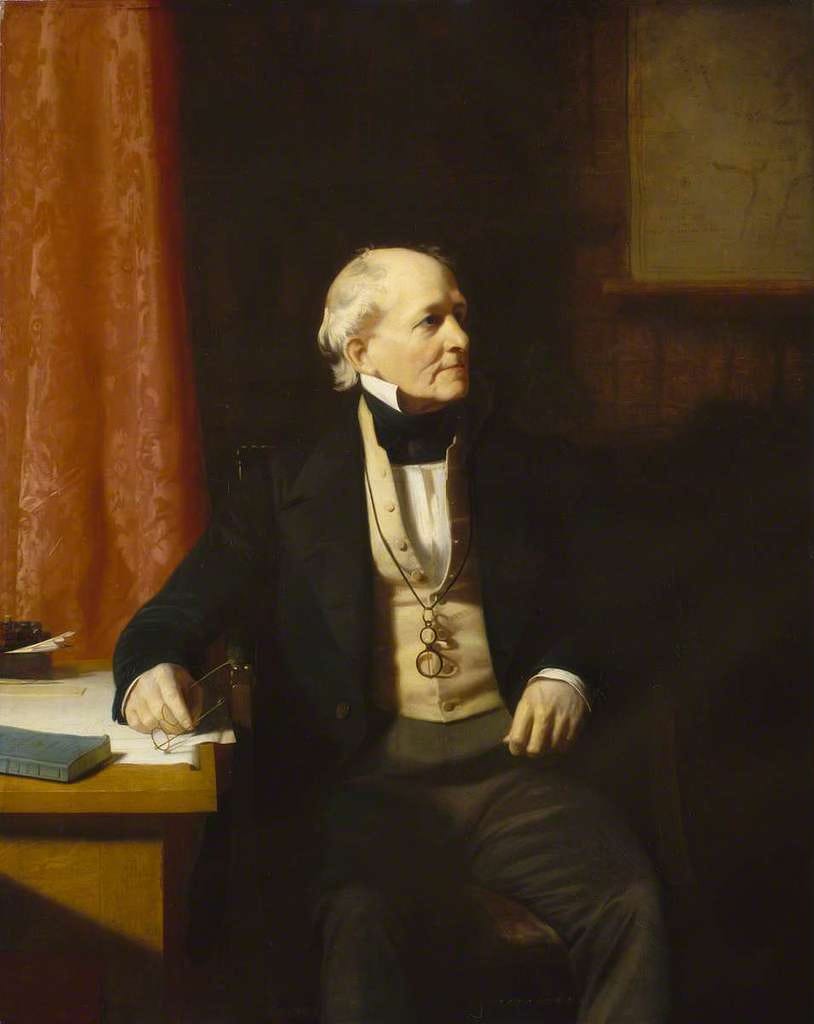
In addition to England, the Beaufort Scale is still widely used in Ireland, Germany, the Netherlands, Greece, Malta, China and Taiwan. This method of relating wind strength to observable phenomena credited to Admiral Francis Beaufort, hydrographer to the British Admiralty, is well known to professional and recreational mariners alike. But what are its origins?
Captain John Smith, the English explorer of Virginia, the Chesapeake and friend of Pocahontas, wrote a book in 1626 which noted “A faire Loome Gale is the best to saile in, because the Sea goeth not high, and we beare out all our sailes. A stiffe Gale is so much wind as our top-sailes can endure to beare.” Anders Celsius, the Swedish astronomer of temperature scale fame, tried his hand at a windforce scale in the early 1700s using the large oak tree in the garden of his observatory. In a grade 4 wind “the trunk itself swayed vehemently”. Later in the 18th century, John Smeaton, the civil engineer most well known for designing Eddystone Light, developed a wind force scale which applied wind names to the strengths needed to turn the blades of windmills.
Smith, Celsius and Smeaton all realized that the actual wind speed, as measured by anemometer, was not as important as the affect it had on a ship under sail, the limbs of a tree or windmill grinding wheat. This is similar to our concept of time. For many centuries, European farmers and craftsmen paced their work day throughout the year from their observations of sunrise and sunset. It wasn't until the widespread building of clock towers in the Middle Ages that work began being regulated by bells striking the hour, as time was starting to be measured by “o'clock”.
It was Beaufort who synthesized the work of those wind pioneers before him and developed the wind scale standard that was adopted for use by the British Navy for ship's log entries starting in the late 1830s. What Beaufort did was develop a thirteen point scale, from 0 to 12, directly related to setting the sails of a frigate under different wind conditions. The frigates were three-masted, squarerigged light warships which made up the bulk of the British fleet. Examples were:
Force 0: Calm
Force 1: Light Air or just sufficient to give steerage way.
Force 4: Moderate Breeze or that in which a man-of-war with all sail set and clean full would go in smooth water from 5 to 6 knots (of boat speed).
Force 9: Stong Gale or that to which a well-conditioned man-of-war could just carry in chase, full and by. Close-reefed top-sails and courses.
Force 12: Hurricane or that which no canvas could withstand.
In the intervening years through the early 20th century, the Beaufort Scale was altered to reflect the shift from sail power to steam power. The empirical values used were changed to those of how the the sea reacted to the wind, or sea state. Land-based observations of wind acting on smoke, leaves, umbrellas, telegraph wires and chimney pots were added as well. Force 6 (Strong Breeze) no longer meant “single reefed top-sails and top-gallant sail”, instead it was replaced with “large waves begin to form; the white foam crests are more extensive everywhere. Probably some spray.”, and “large branches in motion; telegraph wires whistle; umbrellas used with difficulty”.
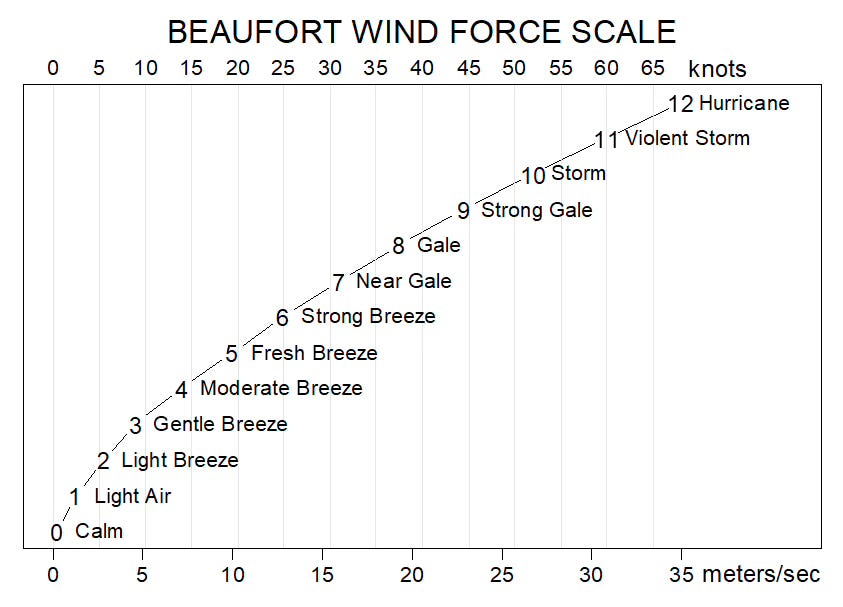
Today, the modern Beaufort Scale correlates the Beaufort force number, wind description, windspeed, wave height, sea conditions, land conditions and a photo of the sea state in one table. When a new deckhand aboard a large yacht writes in “F5” as the wind speed log entry during their nighttime watch, they are tracing our maritime heritage back to the days that Britannia ruled the waves.
Very insightful and well written articles. You have a gift for articulating your stories perfectly. Keep writing!
Very enjoyable read Jeff. I listen to the Shipping Forecast almost every morning before I get up and relied on it for many years as a Merchant Navy navigating officer. I look forward to more stories like it. Pete McArdle.